Capital City Arts Initiative
Site Under Construction - revised 081606
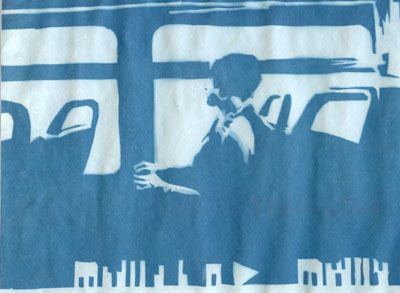
Toni Ortega
"Placeholder Image for Kris' Essay "
Art: What Is It Good For?
. . .
This essay by CCAI CAP writer Kris Vagner, is a companion to "Art & Real Lif" our spring, 2006 series of artists’ talks that examined some of the ways art and life intersect.
text revised: August 16, 2006
Attempts to answer the question, “What is art?” usually end up unraveling into futility. In a pluralistic culture informed by beliefs and tastes of all sorts, the experts have pretty much agreed to disagree. Or at least they’ve agreed that trying to cast a nice, neat net of definition around art is fruitless.
But the question, “What does art do?” is worth considering every so often for those of us who make it or look at it.
There are historical answers; art has, at times, been didactic, religious or political. There are practical answers: it decorates, it inspires. But the sum of those functions isn’t substantial enough to explain why artists carve out time, space and resources to devote to laboring over paint, steel or pixels for the sake of making something that represents their ideas. Nor does it explain what keeps legions of arts administrators shepherding artists and their output through the complex, competitive processes of production and exhibition.
While answers to the question “What does art do?” are potentially leaden with obviousness, they could just as easily be vague or elusive. As an artist and arts writer, I try daily to articulate some version of an explanation, but I continually find myself at the double-edged risk of speaking too bluntly or waxing too effusively on the subject, and I’ve never come up with a solid answer.
So I asked Carson City and Reno-area artists and arts administrators about what art does for them.
In an attempt to set up a fair comparison, I narrowed the question down further. After a season of asking artists to speak to CCAI audiences about how their work relates to the world outside their studio doors, I posed this more specific question: “Does art provide an escape from the real world? A reflection of the real world? Both? Or something else entirely?”
Even with the question pared down to this level of detail, it turns out it was about as simple to answer as “What is art?”
I sit at my desk, at my house, in Reno, late at night, placing crumpled paper or ice cubes or chips of paint on my flatbed scanner. I scan these things, or whatever is lying around, then manipulate the images on my screen. I tweak the color, skew the scale, and, most fun of all, obliterate the focus. Usually, the moment I start to consider an image successful is when all references to the “real world” are edited out or obscured, and I’m left with not much but a graphically balanced trace of light or smear of color, and, if all goes well, a satisfying air of mystery.
In this sense, my work is unabashedly escapist. I’m not trying to make a point. If I had something to say, I would simply say it (or, more likely, write it). Therefore, I fancy my artwork free from the rules of syntax. In other words, I can just make things up, and I consider making things up to be one of the best uses of my time. Sure, some people won’t get my work, and some people won’t like it, but that’s no cause for despair.
When my work is at its best, it’s a visual refuge, a temporary resting spot. Playing with Photoshop filters gives me what most people find in television: a mental off-switch.
I acknowledge, though, that there is no such thing as escape from the “real world.” And there is no such thing as freedom from the rules of syntax. For source material, I draw from everyday things because, well, what else is there? The only access I have to some alternate universe is the one I create, temporarily, by asserting my will over little scraps of whatever is handy.
Erik Burke, a Reno- and Sacramento-based muralist, does the opposite. He jumps head-first into “real life.” His murals don’t stop at beautifying an overlooked urban space with bold, outdoor paintings; they reflect the surrounding community in a direct, one-person-at-a-time way. He works in alleys and parking lots, where he depends on the chance elements of other people’s participation. He often works with other artists, and he often consults with strangers passing by.
“Even when I’m not collaborating, I end up collaborating with random people,” Burke says. For his mural behind the Virginia Street Starbucks, he shot photos of people who stopped to talk while he was painting a picture of a twin-lens camera on a cinder-block wall. He included painted versions of the snapshots as part of the mural.
In Burke’s mind, the distinction between public space and private space is not clear-cut; it’s more like the world is his game board. For a 2005 exhibit at Never Ender Gallery, he stenciled the word “gallery” onto fences, curbs and exterior walls, shot photos of the stenciled word, and offered for sale, for $20, management rights to one’s own “gallery.”
While, in one sense, he creates his own reality by reinterpreting rules of private property (sometimes to the extent that he’s treading the line of legality), his source materials and subject matter are the people, places and things he sees on the street, rearranged, made into art.
As Burke says, “I feel that in my way of doing public art, there’s no way to escape the world. It’s embracing the world.”
Jeff Erickson, a Carson-City-born artist who lives in Sparks, borrows from the least subtle of topics: politics, religion, or war. He distills them and repackages them as graphics or symbols in his paintings, sculptures, and public art installations. He says of his work: “It’s absolutely a reflection of the society that we live in. I use visual cues, symbols, signs that I see in politics and society, and I incorporate those into my work as metaphors.”
His work doesn’t end up as a visual edict though. Some of his symbols are used loosely, some directly. Each of his target paintings or steel and resin sculptures will communicate something different to each viewer.
Visual art, for Erickson, is a way to record and catalogue his observations of the world, to parse out the subtexts enough to make some sense of things, then pare them down into physical records of his thought process.
Toni Ortega gathers and sorts the details of ordinary life too. She shoots photographs of the “negative spaces” in between buildings, spaces that aren’t used for anything in particular. In one series, she translated photos of bus stops and other non-locations into paper cut-outs. She used the cut-outs as paper negatives to print photograms, ending up with solid-color silhouettes. They look like drawings, but the glossy paper they’re printed on is unmistakably photo paper.
In her work, there’s no clear distinction between drawing and photography, between making and documenting. She’s doing both. “There really isn’t a huge separation between the everyday and art,” she says. She uses artmaking to help her define what reality is.
“I immerse myself in it then I get to experience life in a new way all the time,” she says. “I do art to take the time to really think about the normalcies of life and appreciate them.”
Each artist had a well-thought answer to my question about whether art was an escape or a reflection of reality. It was an unfair question. It assumed a dichotomy that may or may not be relevant to their approaches to making art. But each had examined their work from enough angles to talk about it within just about any sets of parameters that are thrown at them.
People who deal with art after it’s made¬¬—curators, collectors, and administrators— were quicker to call me on posing the concept of artmaking so simplistically.
Attempts to categorize art this way struck Frank Hill, a Reno art collector, as bull-headedly academic. Hill, whose taste leans toward otherworldly images of the real world (Reno artist Christine Karkow’s obscured cityscapes, for example) responded, “How can you categorize something like that? ... Art’s the one thing, whether it’s visual, theater, whatever, that you don’t have to stick into a category.”
Kirk Robertson, director of Fallon’s Oats Park Arts Center, a cosmopolitan gallery and performance venue in a rural area, said, “It’s obviously both, depending on what you’re talking about.” For him, visual art provides a new way of looking at things. The best, according to Robertson? “I prefer things that are rooted in the real world but take me somewhere else.”
Natasha Bourlin is the marketing manager for Reno’s Artown festival, a citywide collaborative marketing effort that also brings in out-of-town performers and promotes the arts throughout July. She says the reason she spends her time promoting art is that she gets a charge out of the emotional, physical, or spiritual traces of an individual artist that emanate from a particular piece. Bourlin is intrigued by the idea that art can offer a glimpse into someone else’s thought process or perspective.
“I believe in other people’s outlook on the world,” she says. “I can’t imagine not having the desire to see the world from somebody else’s viewpoint.”
Nevada Museum of Art Curator Ann Wolfe amended the question. “Escape” from the world struck her as impossible, and “reflection” too passive.
She explains her take: “Behind every piece of art, of course, there is an artist, and when I discover a painting, photograph, sculpture, etc., that stirs me both emotionally and intellectually, then I feel an immediate link to that artist. ... For me, this type of visual communication is very much about engaging with ideas and the world, rather than an attempt to escape from such dialogue.”
While each person I interviewed had a good idea of what art did for them, Wolfe articulated a subtext that everyone seemed to be hinting at: that what art does best is represent the individual who made it.
Which is actually not far off from being a definition of what contemporary art is. A successful artwork is a lens through another person’s mind, a record of their experiments, their viewpoints, their experiences in navigating through life. For any one piece of artwork, some people will get it, some people will benefit from it, some people will dismiss it or ignore it. For any one viewer, some work will provide a glimpse from someone else’s vantage point, either comfortably familiar or challengingly new, from which to see, and maybe help us understand a complicated world.
revised 081606